>
Worldwind / Sound Division
← All volumes
Volume 05

Freestyle & Tribal

Latin freestyle, electro and Afro club, 1983–1990
Tempo 120 BPMSwing 53.3%Key F minorDrums 6 × 3 kitsPatches 9
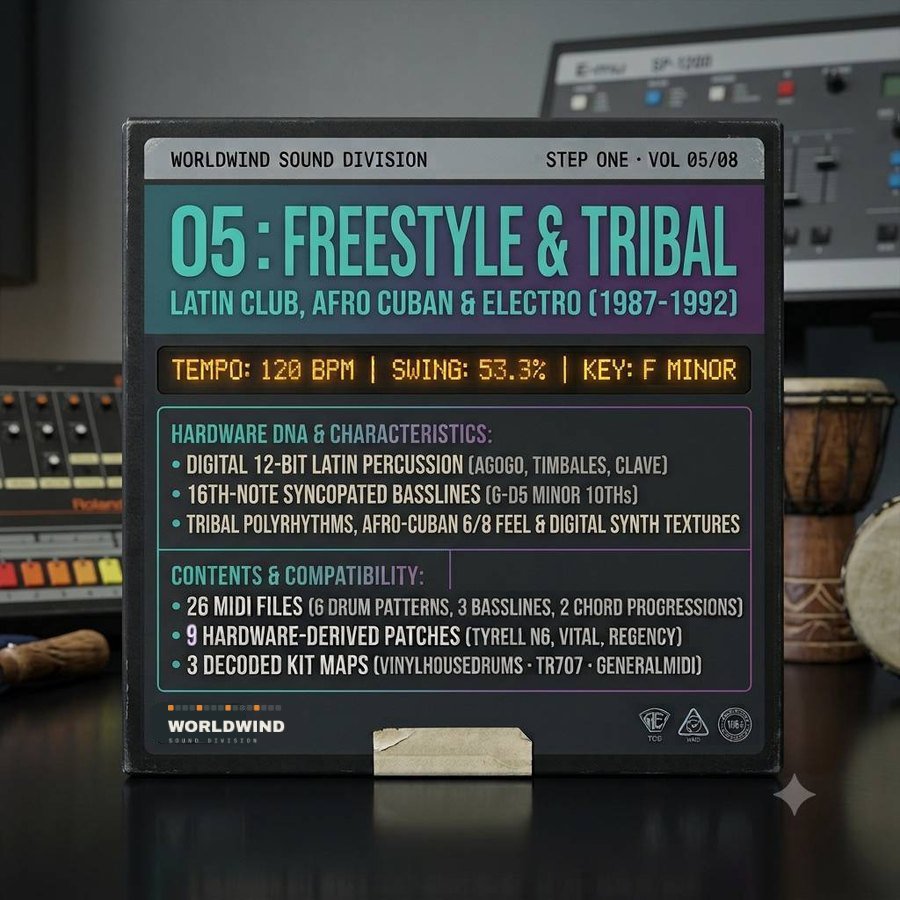
Freestyle and Tribal volume cover
Volume 05 · Step One
Listen — Freestyle & Tribal
0:00

Where it came from

The same New York and New Jersey clubs that played gospel house on a Friday were playing something rougher on other nights. Latino and Black teenagers had absorbed Kraftwerk through Afrika Bambaataa and New Wave through the radio, and what came back out was freestyle: syncopated electro drums, Spanish-inflected melody, and cheap digital synths.

Alongside it ran a tribal strain - records built on hand percussion and chanted vocals rather than song structure, of which Cultural Vibe's 1986 record on Easy Street is the best-known example. Tony Humphries edited that one for the floor, cutting it to maximise space and echo.

Both strands share a rhythm-section philosophy: the bass never lands where the kick does.

How it works musically

Straighter than Chicago - 53% rather than 56%. These records drive forward instead of rocking side to side, and some of them are dead straight.

Two drum approaches. Freestyle breaks the kick entirely: it hits the downbeat, skips beat two, and bounces on the off-sixteenths, with a clap flamming into the snare. Tribal keeps four-on-the-floor but hands the sixteenths to a rimshot rather than a hi-hat, which is why those records sound like wood rather than metal.

The bass is the interesting part. In the tribal pattern here it lands on a kick step exactly once per bar - everything else sits in the gaps. That single point of agreement is what anchors it; the rest is pure push and pull.

Sounds are digital: FM and phase distortion rather than analogue filters. Sharp, metallic, rubbery. Keep note lengths to exactly one sixteenth or the envelope will not retrigger and the snap disappears.
$15
Volume 05 · instant download
Royalty-free for your own releases
Buy this volume

The patches

Chant PadTyrell N6

One sustained pad for the tribal breakdown. Slow attack, long release. Sits under the percussion and chant while the drums carry the groove.

Electro StabTyrell N6

Sharp digital brass stab for freestyle. Sync for bite, fast decay, bright. Punch these on the snare hits the way freestyle records do.

Hollow ResoTyrell N6

Metallic hollow bass. Detune and pulse-width give a slow beating, some resonance but low enough to keep the body. The tribal low end.

Rubber BassTyrell N6

Digital rubber bass. Oscillator sync stands in for phase distortion. Filter mostly open, resonance near zero, key follow high - that is where the rubbery character comes from. Notes must be exactly one sixteenth long.

Slap BassTyrell N6

FM-flavoured slap. Heavy sync, zero sustain, very fast decay. Percussive - drive it with velocity and the accents will bark.

CZ Rubber AltVital

Second phase-distortion voice, brighter than the main Rubber Bass. Key follow maxed.

Rubber BassVital

Phase-distortion style bass via oscillator sync. Env 2 drives the sync amount, which is the digital equivalent of a filter sweep. Square carrier underneath for body, sine sub for weight. Key tracking high - that is the rubbery character.

Slap BassVital

FM slap. Osc 2 is a silent modulator an octave up, Osc 3 a clean parallel carrier for body - the modulated and unmodulated tones run side by side, which is how four-operator hardware actually made these sounds. Zero sustain.

PD Rubber BassRegency

The Ma Foom Bey rubber bass on a real phase-distortion engine. Hardest sweep, filter mostly open, key follow low so brightness stays even. Notes one sixteenth long.

The other volumes