Build the sound of house without spending a fortune
House was never about expensive equipment. It was about imagination, and some of the most influential records ever made came out of gear nobody else wanted — a bass machine Roland discontinued after two years, a drum box that got passed over for the one everybody chased. Those machines cost a fortune now. The character doesn't. Here are the free plugins that get you there, what each one actually replicates, and what it doesn't.
JC-303
The machine that accidentally invented acid house
Roland built the TB-303 as a bass accompaniment box for guitarists practising alone. It was terrible at that, sold poorly and was discontinued inside two years. Cheap secondhand units ended up with Chicago producers who had no use for realistic bass — and the moment they started pushing the filter and letting notes slide into one another, a failed product became the voice of a genre.
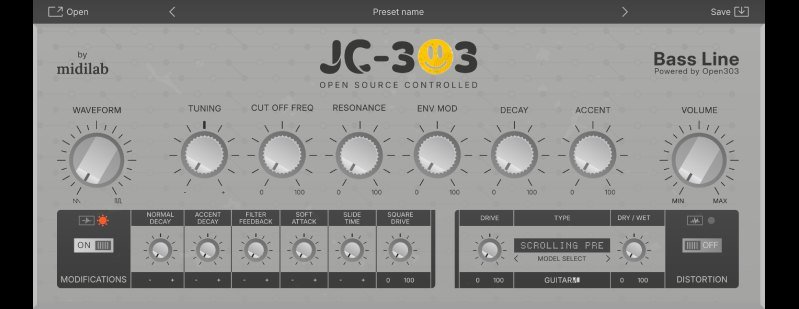
JC-303 by midilab, running the Open303 engine
JC-303 is the only plugin on this page that is a true emulation in the strict sense. It runs the Open303 engine, a project Robin Schmidt started on the KVR forum in 2009 that turned into more than a decade of oscilloscope work and circuit reverse-engineering. Acid Voice, who review 303 clones for a living, place it directly behind the commercial options from AudioRealism and D16 — both of which cost money.
It reads the two conventions that make a 303 line work. An accent is any note at velocity 100 or above, which snaps the filter further open. A slide is any note overlapping the next, which stops the envelope retriggering so the pitch glides. Both live in the MIDI, so a properly written file drives it with no setup. It also carries a GuitarML overdrive section and a set of the Devil Fish filter modifications.
Perfect for
Acid basslines, Chicago house, evolving filter performances
Why we recommend it
If you want authentic acid, start here and don't bother with anything else.
The Juno family didn't become important because it was complicated. It became important because it was usable — warm chorus, wide chords, and a filter that could stay out of the way when the low end needed room.
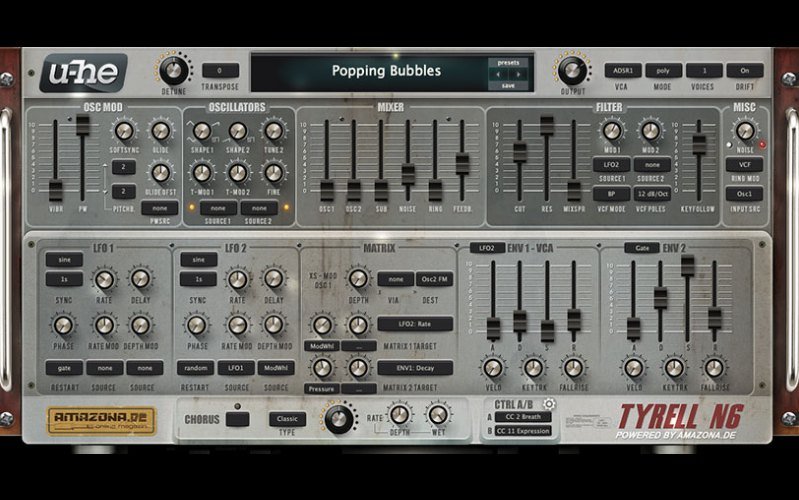
Tyrell N6 by u-he, built on early Diva code
Tyrell N6 has an unusual origin. In 2010 the German magazine Amazona.de ran a reader survey to design an affordable analog synth, and Mic Irmer shaped the responses into a concept based on the Roland Juno 60. Building hardware proved impossible, so Urs Heckmann of u-he offered to make it software instead — quickly, because most of the features were already sitting in an early version of Diva, u-he's flagship analog emulation, which is neither free nor cheap. Tyrell shipped in April 2011 and has been free ever since.
So it is not a Juno emulation the way JC-303 is a 303 emulation. Nobody reverse-engineered a circuit. What you get is a virtual analog built on serious analog-modelling code, arranged in a Juno-derived architecture — and that chorus is doing more work on early deep house records than any other single component. Its filter also scoops the low end as resonance climbs, exactly like the hardware, which is why the deepest house basses are the least resonant ones.
One more thing worth knowing: the stock interface is not the only one. u-he host a PatchLib skins page with alternative interfaces built by the community, so if the default brushed-metal look is not to your taste you can change it without changing the sound.
Perfect for
Deep house chords, analog bass, Detroit string stabs, gospel organ
Why we recommend it
One of the finest free analog synths ever released, and it inherits code from one people pay well for.
Casio's CZ series used phase distortion, a method invented largely to sidestep Yamaha's FM patents. Rather than filtering a rich waveform down, it warps the phase of a simple one, changing its harmonic content directly. That is where the hollow, rubbery CZ character comes from, and why it turns up across New York garage and freestyle records — the CZ-101 was cheap and everywhere in the mid-eighties.
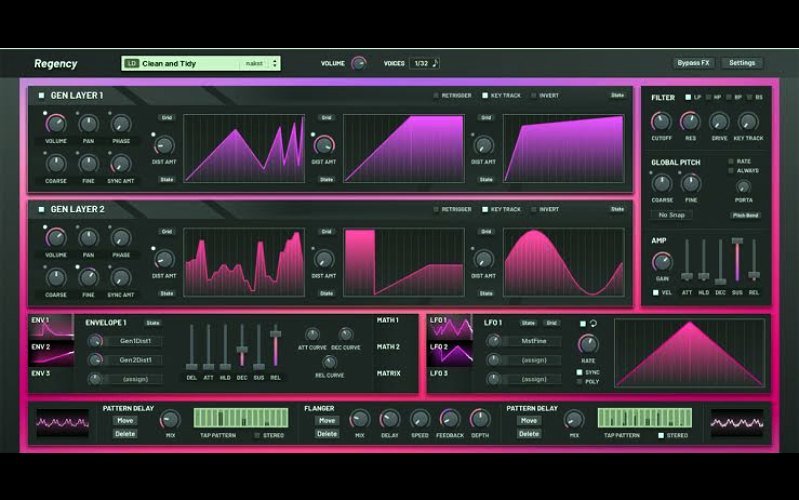
Regency by nakst — two generators, three curves each
Regency, by nakst, uses the same method without being a clone. Where the CZ had a single digital control waveform, Regency gives you two generators with three distortion curves each, chained in series, and you can draw the curves by hand.
The consequence worth knowing before you load it: there is no filter cutoff. The distortion amount knobs are the tone control, and an envelope routed to a curve's depth is the equivalent of a filter envelope. Set the depth high and there is nowhere left to sweep, which is why a patch that looks correct can sit there doing nothing.
Perfect for
Organ bass, digital stabs, metallic textures
Why we recommend it
A fresh take on the Casio CZ approach — and it holds its low end where analog emulations thin out.
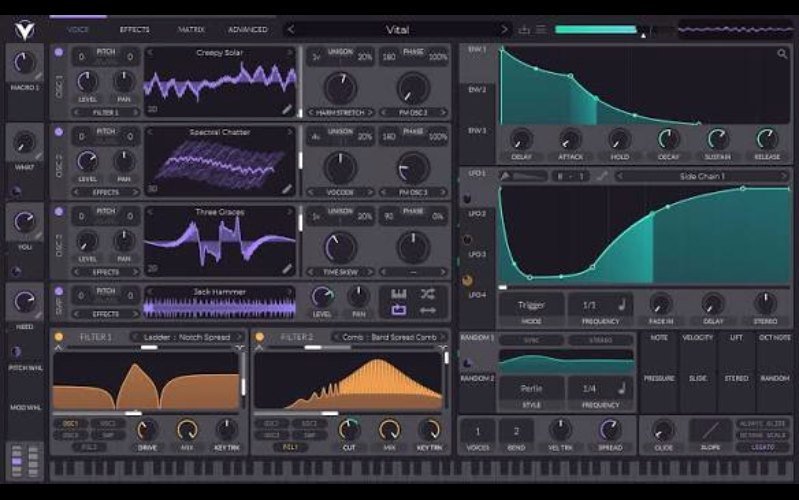
Vital emulates no particular hardware. Matt Tytel built it in 2020 as a spectral-warping wavetable synth, closer in spirit to Serum than to anything from the eighties. It belongs here because house has always borrowed from FM when it needed something clean, bright and punchy — DX7 slap bass, digital bells, rubbery low end, sharp attack.
Vital by Matt Tytel — wavetable, with FM and sync
The free tier is unusually honest: all three oscillators, both filters, the full modulation matrix, every effect, and the same synthesis engine as the paid versions. What you don't get is content — 75 presets and a smaller wavetable collection. Building patches from scratch, that costs you nothing.
One technique matters more than any preset here: run a clean, unmodulated oscillator alongside the FM'd one. FM alone goes thin and choppy in the bass register. The clean oscillator supplies body, the modulated one supplies bite. Four-operator hardware did this by design, and reproducing it is the difference between a convincing FM bass and a brittle one.
Perfect for
FM bass, digital leads, sub layers, modern house
Why we recommend it
Incredible flexibility with a genuinely generous free version.
Drums are where the "you need the hardware" argument falls apart fastest. A 909 has no keyboard, no velocity response and no drift — it fires the same sound every time. What it does have is a row of knobs, and Chicago and Detroit producers turned them constantly: tuning the kick down, stretching the decay, riding the snare. That distinction is why there are two different ways to do this, sampled and synthesised, and both are covered for free.
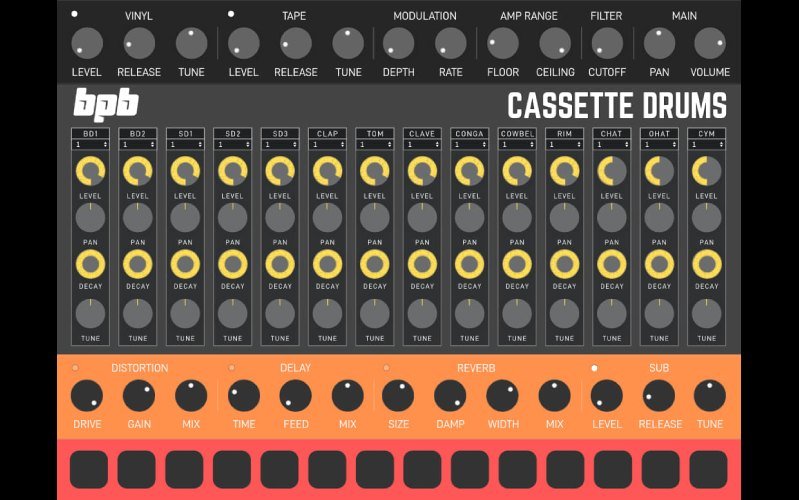
BPB Cassette Drums — start here
Thirteen kits covering the TR-808, TR-909, TR-606 and MFB-522, recorded through a SABA tape deck and a TASCAM 244 Portastudio, with clean, warm and hot versions of each machine so you choose how much saturation you want. Fourteen channels with decay and pitch per drum, multi-out, and built-in distortion, reverb, delay and vinyl. VST, VST3 and AU on Windows and macOS.
BPB Cassette Drums — 808, 909, 606 and MFB-522
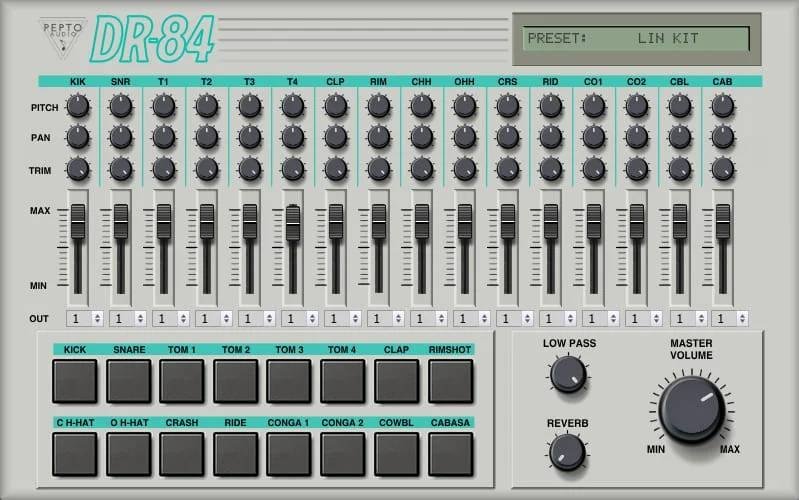
DR-84 — 707, DMX, LinnDrum and more
Pepto Audio's DR-84 gathers the machines that actually built eighties dance music into one free plugin: LinnDrum, Roland TR-707, E-MU Drumulator, Oberheim DMX, Yamaha RX11 and the Simmons SDSV, across fourteen kits. The samples are left unprocessed to preserve the original character, apart from three modern synthwave kits.
DR-84 by Pepto Audio — six machines, Windows and Mac
Pitch, trim, pan and volume per drum piece, a low-pass filter, reverb and multi-output. It is 64-bit for both Windows and Mac, as VST, VST3 and AU — the only drum option here that covers macOS properly. Free, with a donation link if you want to say thank you.
The DMX matters as much as the 707 here. It was the machine underneath a great deal of early New York and New Jersey club music, sitting alongside the 707 rather than the 909 everyone chased.
One thing to set up: DR-84 uses its own MIDI layout and it is not the one our drum folders use. Kick, snare and clap land correctly at 36, 38 and 39, but its closed hat sits at 44 and its open hat at 45, where our files expect 42 and 46. Move those two notes up and down respectively and everything else falls into place — Our TR707 folder follows the standard 707 layout, so it drops into DR-84 with just those two hat notes moved. See _REFERENCE/KIT_MAPS.txt in the library, which now carries DR-84's full layout.
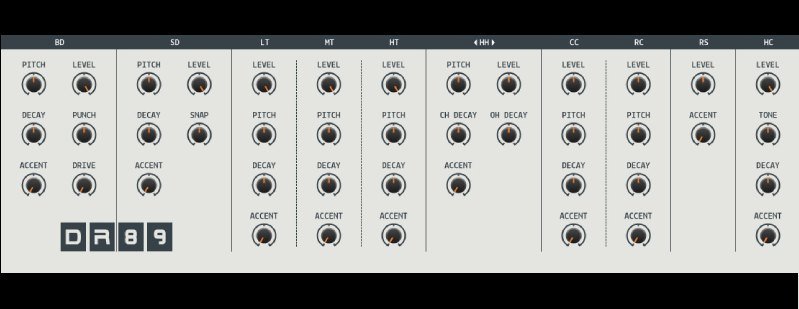
DR.89 — when you want the knobs back
Sender Spike's DR.89 is not sample-based. It is a synthesised drum machine modelled on the 909's circuit topology, built because samples didn't offer enough flexibility. A sampled 909 kick is frozen at whatever the knobs were set to when someone recorded it; this one can be tuned and reshaped without artefacts. Windows only, 64-bit VST2.
DR.89 by Sender Spike — synthesised, not sampled
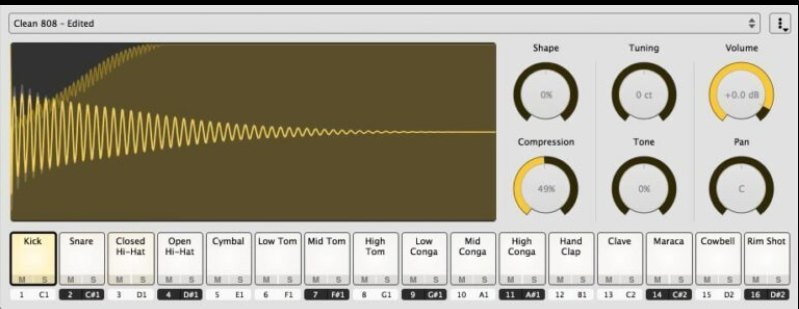
Sitala — for your own samples
Decomposer's Sitala is a general sampler rather than a drum machine: sixteen pads, drag and drop, a beat slicer, one output per pad, and an 808 kit sampled from real hardware. Its use here is the mapping — it offers General MIDI, chromatic and white-key layouts, so our General MIDI folder drives it with no remapping. VST, AU, AAX and standalone, Apple Silicon native.
Sitala by Decomposer — sixteen pads, General MIDI mapping
The 727, and why it needs no extra work
The TR-727 is a 707 with Latin percussion in place of the trap kit — congas, bongos, timbales, agogos, cabasa, whistles. Same hardware, same MIDI implementation, which means any 707 pattern drives a 727 without remapping a single note. The two machines were built to sit side by side, and on Chicago house, Italo and early acid records they usually did.
Free sources are good here. Kent Williams recorded his own machine and gave the samples away — fifteen sounds captured four ways, including through a guitar amp clean and dirty. And Samples From Mars release their 1,102-sample 727 From Mars pack free every year on the 27th of July, with thirty chromatic pitches per voice recorded off tape. It is 29 dollars the rest of the year.
Free samples, if you'd rather build kits
Wave Alchemy's 909 Tape is free and runs to 280-plus samples of a real TR-909 through tape. BVKER give away 200-plus royalty-free 909 one-shots. MusicRadar's SampleRadar has published free 808 and 909 packs for years — free to use in your music, on the condition you don't redistribute the samples themselves.
Why programming beats sample quality
The first thing is choke groups. On real hardware an open hat and a closed hat are the same circuit, so a closed hit cuts the open one dead mid-ring. Assign both to one choke group and the pattern breathes; leave them independent and open hats pile up into mush.
The second is that a drum machine gets played. Accents, ghost notes, hats at three different levels inside a bar. Sample quality is irrelevant if all sixteen hits land at the same velocity — that reads as a machine because it is one.
Perfect for
Chicago, Detroit, deep and classic house
Why we recommend it
Free tools that deliver the drum sounds behind countless dance records.
A UK maker whose free plugins are aimed straight at this music
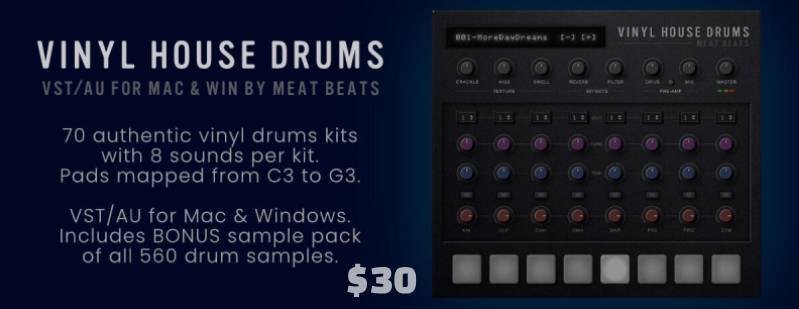
The first of the three drum folders in the library is named VinylHouseDrums, and it is mapped for Vinyl House Drums by Meat Beats — 70 vinyl-sampled house kits, every kit on the same pad layout, which is exactly why one folder maps cleanly across all of them. That one is paid, and it is what these patterns were voiced on. If you would rather stay free, the GeneralMIDI folder covers you and loses none of the programming.
Vinyl House Drums by Meat Beats — the kit the library’s drums were voiced on
Meat Beats also give away several plugins built for precisely this era, and they are worth having next to the synths above:
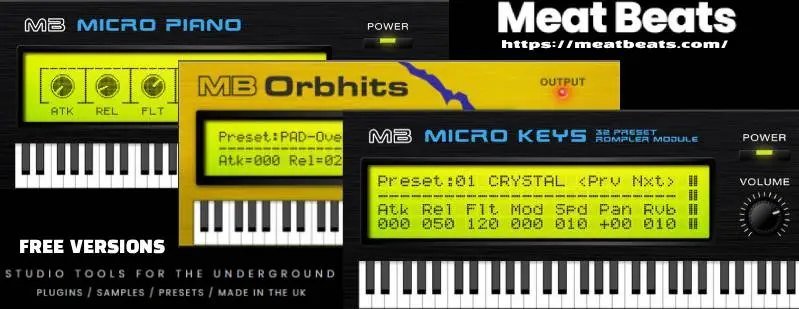
Three free from Meat Beats — Micro Piano, Orbhits, Micro Keys
Micro Piano & Micro Keys
The 90s house piano and the keys to go with it — sampled from the S-series rackmount samplers, crunchy attack and sizzling tone. Micro Keys adds electric pianos, organs, strings and a bonus sax. Between them they cover the piano-led side of garage and gospel house that the synths above do not. Both free.
Orbhits
170 rave and 90s-house hits, stabs, chords and bass sampled from a classic yellow rack unit. This is the one to reach for on the stab-heavy volumes — NY garage, freestyle, hip-house — where you want a hardware stab rather than a synth patch. Also free.
Free from Meat Beats
Micro Piano, Micro Keys, Orbhits — all VST3/AU, Windows and Mac
Worth paying for
Vinyl House Drums, the kit the library’s drums were voiced on
Play the library’s chords live, and find more in the same idiom
Every volume ships chord MIDI — the ii–V–I turnarounds, the suspended-fourth stabs, the gospel voicings. Two free tools turn those from files you drag in into chords you play.
Ripchord — one finger, whole progressions
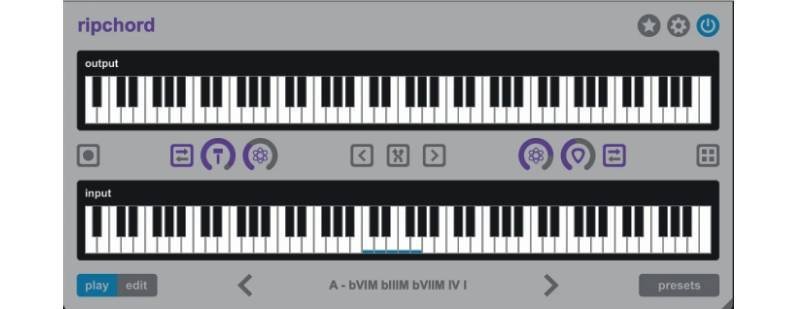
A free MIDI plugin that triggers a full chord from a single key. Import any MIDI file that contains chords and it builds a preset automatically — so you can drop this library’s chord files straight in and play the progressions live, one finger at a time, then record the result back out as MIDI. AU and VST3 on Mac, VST3 on Windows. The developer lets anyone make and share preset packs, which is exactly what the next one is.
Ripchord by Trackbout — the preset shown is a deep-house progression
Musician Paradise — free deep-house chord packs
A producer who gives away a genuinely ridiculous amount of chord and MIDI material built squarely on the soulful and deep house tradition — the Larry Heard, Kerri Chandler, Louie Vega, Frankie Knuckles lineage this whole library draws from. The free smaller packs alone will keep you busy for a long time, and they come in Ripchord format among others, so they load straight into the plugin above.
If you get hooked, the larger collections sit behind his Patreon — but you never have to pay to start. The free tier is not a teaser, it is a proper library on its own.
The tool
Ripchord — free, Mac and Windows, imports your chord MIDI
The presets
Musician Paradise — generous free chord packs in Ripchord format, larger sets on Patreon
The records were mixed on hardware consoles. Half the sound is the reverb and delay
Everything above makes the notes. This makes the space they sit in. The classic Chicago, Jersey and Detroit records ran their stabs, vocals and percussion through plate reverbs and tape echoes on the mixing desk — that smoky, metallic wash is not a preset, it is the room. Two free plugins get you there, and the trick is using them together rather than picking one.
Sixth Sample Deelay — the rhythmic echo
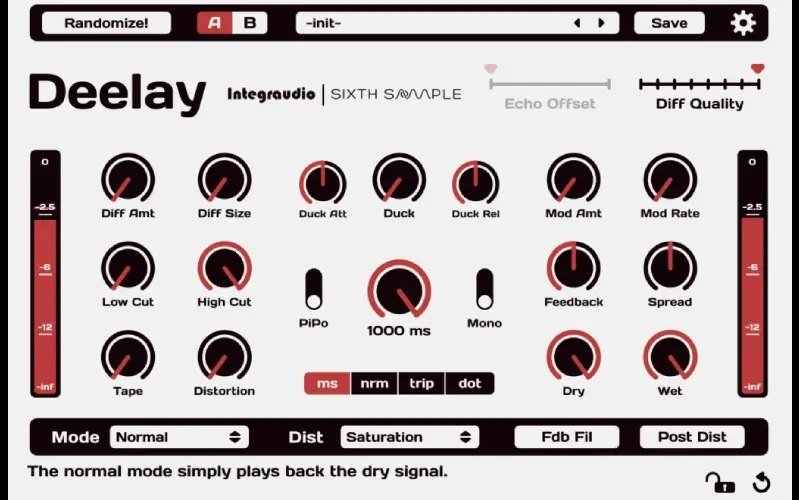
A free delay with a tape mode and a distortion module built in, so you get the dirty, warm echo without a separate bitcrusher. The one to reach for on stabs and vocal snips — set it to a synced 1/8 note for that bouncing, dubby repeat. Keep its Diffusion at zero so the echoes stay crisp and punchy rather than smearing into a cloud. VST3 and AU, Windows and Mac, genuinely free.
Sixth Sample Deelay — note the Tape, Distortion and Diff knobs
Dragonfly Reverb — the plate wash
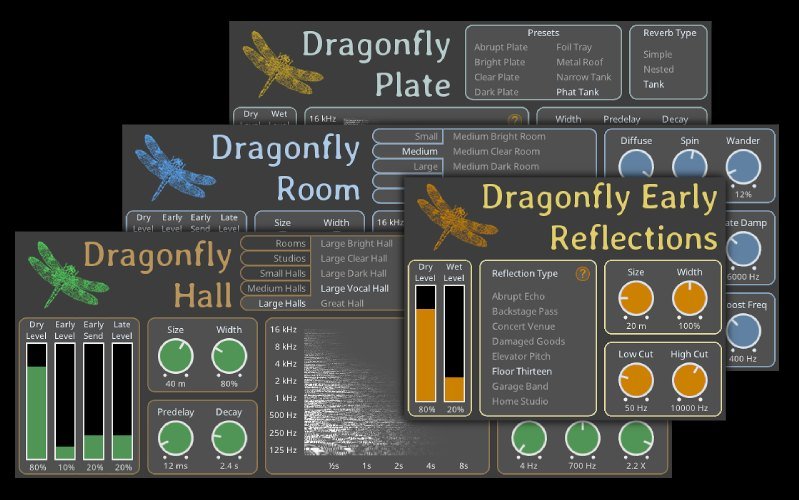
A free, open-source suite of four reverbs — Hall, Room, Plate and Early Reflections. For house, open the Plate and choose the Tank algorithm, which is modelled on the 1980s hardware plates these records used. It has a built-in spectrogram so you can see what you are cutting: set the low cut to 200 Hz and the high cut to around 7 kHz to get that dark, smoky warehouse acoustic vintage gear had by nature. Windows, Mac and Linux.
Dragonfly Plate — the Phat Tank preset, top right
Use them together, on a return
The mistake is putting these straight on a channel. The old records were mixed with shared outboard, so do the same: set the reverb and delay up on 100% wet return tracks and send your stabs, vocals and percussion to the same space. That is what glues a track together. Put an EQ before the reverb on that return and cut everything below 200 Hz so the kick and sub stay clean, then shelf off the extreme highs — the hardware could not pass them anyway.
The last stage: make a clean digital synth sound like a played-out 12-inch
Everything above makes the sound. This is the reason it needs ageing at all — and it is not nostalgia, it is a manufacturing fact. Trax Records pressed on recycled vinyl: Larry Sherman ground up unsold disco records and stamped house onto them for about thirty cents a copy. Those records came with crackle, pops and surface noise the first time you dropped the needle — buyers famously opened new sleeves to find scraps of old paper labels pressed into the wax. The dust was never added later. It was baked in at the plant.
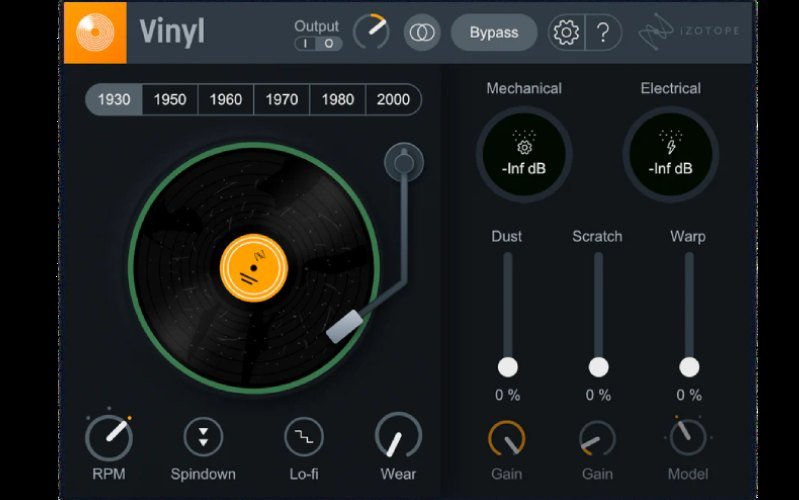
So when you put grit on a clean digital synth, you are not faking a vibe. You are rebuilding the exact artifact that pressing house on the cheapest vinyl in Chicago left on every record. iZotope Vinyl is the free, industry-standard way to do it (VST3, VST2, AU, Windows and Mac).
iZotope Vinyl — set the Year to 1980, Lo-fi on, dust light, warp at zero
The trick is restraint — you want a clean record with age on it, not a broken one. Settings that get the Chicago vibe rather than a modern lo-fi beat:
Year
Click 1980 — tightens the highs and lows into a mid-focused, radio-ready band
Lo-fi
On — the button bottom-left adds the subtle bit-crush of an early 12-bit sampler
Dust
~15–20% — a faint background crackle, not a storm
Scratch
Low, ~5–10% — the odd click, kept sparse
Wear
~10% on the knob — gently rolls off the highs like a played-out record
Warp
0% — house runs on a rigid tempo; wow and flutter would smear the groove
Where to put it: on the master channel, at the very front of the chain, before any compressor or limiter. That way the dust and crackle get compressed along with the kick, so the noise moves with the track instead of floating on top — it reads as one cohesive vinyl block rather than an effect laid over the mix.
Two more free options if you want to age it differently: Cymatics Origin has a resampler that catches a crunchier test-pressing character, and Caelum Audio Tape Cassette 2 leans tape rather than vinyl — warmer saturation that suits deep-house chords.
Real 303 filter behaviour, reads slides and accents from MIDI
Deep house chords
Tyrell N6
The chorus, and a filter that behaves like the hardware
Jacking square bass
Tyrell N6
Fast envelopes, mono, filter almost shut
Hollow organ bass
Regency
Phase distortion keeps the low end under a bright tone
DX7 slap bass
Vital
FM with a clean parallel carrier for body
Detroit string stab
Tyrell N6
Two detuned saws into chorus
Gospel organ
Tyrell N6
Both oscillators square gives the woody DX7/M1 tone
Sub layer
Vital
Clean sine, no distortion, nothing to get in the way
90s house piano
Micro Piano
Free. S-series sampler piano, crunchy 90s tone
Rave and garage stabs
Orbhits
Free. 170 hardware stabs, chords and bass
Play your chord MIDI live
Ripchord
Free. Triggers full progressions from single keys
Rhythmic tape echo on stabs
Sixth Sample Deelay
Free. Tape + distortion built in, Diffusion at 0%
Vintage plate reverb wash
Dragonfly Plate
Free. Tank algorithm, modelled on 80s hardware plates
Dusty vinyl finish on the master
iZotope Vinyl
Free. Year 1980, Lo-fi on, light dust, warp at zero
909 kick and clap
Cassette Drums
Real 909 samples, clean or tape-saturated, one download
707, DMX or LinnDrum
DR-84
Six machines, unprocessed samples, and it runs on Mac
Tuned or stretched kick
DR.89
Synthesised, so the knobs still work — Windows only
Open hat that breathes
Any of them
Choke groups let a closed hat cut the open one, like the circuit did
You already own the instruments
The plugins are free. The craft is knowing how to program them.
All of them install in minutes and cost nothing. That is genuinely the easy part, and having them does not get you the sound.
What takes the time is knowing that resonance near zero is what protects the sub, so the deepest bass patches are the least resonant ones — the opposite of what the knob invites you to do. That an accent on an FM patch has to change tone and not just level, because velocity drives the modulation index. That a clean, unmodulated oscillator running beside the modulated one is the difference between a bass with body and one that sounds brittle. That on a phase distortion synth the curve depth has to start low or the envelope has nowhere to sweep it. That an open hat and a closed hat belong in the same choke group, because on the hardware they were one circuit. And that note lengths carry meaning in both directions — overlap two notes on a 303 and you get a slide, overlap them on an FM bass and you delete the attack.
None of that is in a plugin. It is the part nobody wrote down, and it is the difference between a patch that sounds like a demo and one that sounds like a record.
Free download · no card needed
Hear it before you buy it
Nine MIDI files and three patches pulled straight from the library. Two drum patterns sit side by side so you can hear the thing this whole collection is built on — Chicago at 55.8% against New York garage at 57.9%, where the percussion swings and the kick stays locked.
These free tools are what the library was built to be played through. Each volume ships the MIDI, the patches and the swing already programmed — drop it into the plugins above and you are hearing the record, not a demo.